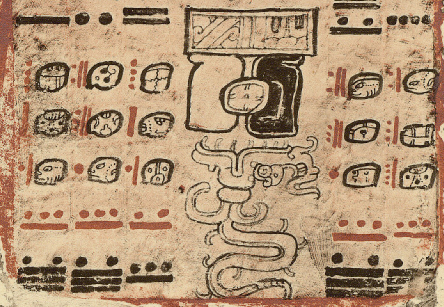
| Numeration | Calendars | Dates | Stelae | Codices | Architecture | Bibliography | Appenda The Mesoamerican civilizations constructed numerous administrative and ceremonial centers and erected numerous monuments. These reflect astronomic knowledge and expertise in numeration and calendrics. This paper is an inquiry into the present level of knowledge of astronomy in prehistoric Mesoamerica and the level of prehistoric astronomic knowledge. Information comes from architectural relationships, stone monuments, codices and ethnohistorical manuscripts. The primary sources are the inscribed stone monuments and, in particular, the Dresden Codex. Ethnohistorical sources furnished useful keys for deciphering primary sources. Early Discoveries One of the primary resources for study of Maya astronomy is the epigraphic record in four Mayan codices containing hieroglyphic writings that survived the widespread Spanish book burnings of the conquest period. The rediscovery of these volumes in European libraries in the mid-nineteenth century marks the beginning of modern inquiry into the intellectual achievements of the Maya. Post conquest writings depicting calendrical cycles and numeration played a role in the decipherment of Maya script. In particular, the work of Diego de Landa presented Mayan calendar glyphs. Landa reported the two types of months noted in Yucatan, and that the lunar month began with the appearance of the new moon. Landa also reported that the New Year began on 12 Kan 1 Pop in 1553 (Malstrom 1991), a correlation that later proved useful in aligning Mayan and modern calendars. During the 19th century Abbé Brasseur de Bourbourg recognized the day glyphs after discovering de Landa's Relacion de las Cosas de Yucatan. Landa provided drawings with the corresponding month names, and presented the four glyphs that fall on the initial days of the months, the year bearers. He also provided a calendar with European months correlated with the Native calendar, the names of calendar cycles, and some other hieroglyphic symbols related to European alphabetic signs (Leon, 1994). This information led to understanding the sequence to read the glyphs and the decipherment of the Long Count notation. Brasseur de Bourbourg also identified the sun or kin glyph, the glyph associated with the day. Ernst Förstmann identified the Venus glyph on the basis of its recurrence in the Venus Table of the Dresden Codex, which he discovered. Förstmann noticed the sum of a row of numbers totaled 584, equated with the synodic Venus cycle of morning star, disappearance, evening star and inferior solar conjunction (Förstmann 1906). He also recognized the eclipse intervals of 177 and 146 days. Förstmann, in 1895, made a valuable contribution in identifying the celestial bands in the codices as a distinct type of hieroglyphic composition representing cosmic entities. He was the first to identify the celestial band hieroglyphs in the Dresden Codex (Collea 1981). In 1906 Zelia Nuttall published an article about astronomical drawings in the codices. The Central Mexican crossed-stick glyph is considered a foresight symbol and often appears atop a pyramid or adjacent to individuals. An eye is placed between the sticks in most of its presentations. Morley mentioned, in a letter to Bowditch in 1909, the near-north alignment of Mayan buildings (Aveni 1981). Edward Seler, in 1917, interpreted a bar and dot eight symbol on a Venus mask at Uxmal as related to the eight day inferior conjunction of the planet. Also in 1917 Herbert Spinden concluded that depictions in the Paris Codex represented a possible thirteen constellation zodiac (Severin 1981). In 1925 John Teeple recognized the lunar month multiple in the glyphs frequently appended to the Long Count inscriptions. Teeple determined that the Lunar Series glyphs represented the age of the moon. In 1937 Alexander Pogo compared dates in the Dresden Codex with actual observable eclipses in the Maya region, concluding that the tables dealt with lunar, not solar, eclipses (Gibbs 1977). By this time it was generally accepted that the prehistoric civilizations of Mesoamerica had advanced astronomic knowledge relative to their contemporaries in other parts of the world. In the remainder of this paper those understandings are examined by areas of evidence, beginning with the fundamentals underlying the practice of astronomy, numeration and calendrics. |
|
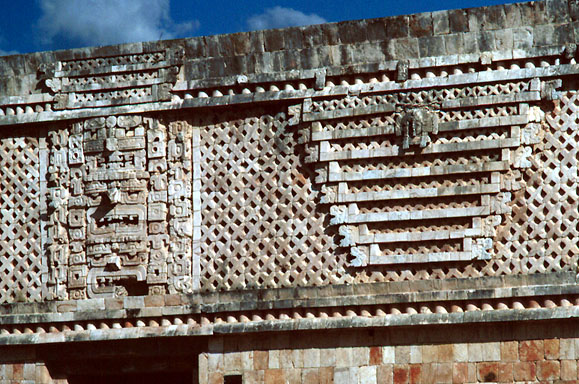
According to O. G. Rickerson, Frans Blom, in 1924, surveyed Uaxactun and recognized that the easternmost plaza, Group E, probably functioned as a solar observatory (Aveni and Hartung 1989). The cardinally aligned Group E is situated on an 200 x 100 meter elevated artificial terrace. An elongated terrace mound on the eastern edge is topped by three west facing structures. Fifty meters to the west is pyramid E-VII sub, a structure that never supported any building. As viewed from E-VII the three eastern mounds and their structures marked the extremes and midpoint of the sun's rise position relative to the horizon. Aveni and Hartung (1989) made accurate measurements of the alignments and found a satisfactory fit, concluding the structures would have made an adequate solstice observatory, though not an equinoctial one. These authors also noted that the alignment of the E Group, on a North-South axis, points almost exactly to the center of Tikal. Ruppert (1934) reported the widespread occurrence throughout the Peten of complexes resembling Uaxactun's E Group, listing 19 sites, of which 13 sites had unmistakable resemblance. Based on studies of site maps, Aveni and Hartung concluded that none of the other Group E complexes could then be classified as actual observatories and may have been more symbolic. Mayan architectural alignments have been shown to relate to horizon positions of astronomical bodies. Both Edzna and Teotihuacan have orientations to the sunset on Aug. 13, the first day of the present Long Count (Malstrom 1991). Malstrom also notes the coincidence of the alignment of the two principal pyramids at Edzna (Cinco Pisos and La Vieja) with the lunar standstill. He concludes the Cinco Pisos may have been the earliest lunar observatory identified in Mesoamerica. A well documented and studied case is the Palace of the Governors at Uxmal. Puuc centers are often grouped about a N-S axis and nearly all Puuc buildings are oriented near 14 degrees East of true north (Segovia 1991). The Palace of the Governors does not conform to the rest of Uxmal's orientation. It is built upon a 200 meter on a side platform mound (Aveni and Hartung 1991) with the long walls oriented facing the southerly standstill position of Venus during the era 750 AD. Venus horizon extremes follow an annual cycle, following the sun, and an eight year period. At about 6 km. distance, the mound of Nophat marks the 28° 13' S. of E. position, the Venus extreme (Aveni 1981). Venus iconography also adorns the palace facade. The same Venus glyphs found in the Venus table of the Dresden Codex are found in the facade. Thus, the iconography of the building supports the interpretation that it is oriented to Venus' southerly rise. There are also Venus glyphs on the Nunnery facade, as well as groups of 584 x's in some of the facade designs. As early as 1917 Eduard Seler had hypothesized a relationship of the Palace to Venus based on the iconography (Aveni and Hartung 1991). Uxmal also has an alignment to summer solstice and one to due north. The western orientation of the Castillo at Chichen Itza faces within a degree the zenith passage sunset. The east faces sunrise at the time of solar nadir. The Upper Temple of the Jaguars and the Temple of the Warriors align to the zenith sunset. The Castillo has 365 steps. The Caracol at Chichen Itza is recognized as an astronomical observatory (Milbrath 1988). The Caracol has three Venus alignments, including the building's alignment to the northerly extremes of Venus. A pair of turret window alignments and a pair of base alignments point to Venus' western horizon standstills around 1000 A.D. The Caracol's platform, an irregular rectangle, has a diagonal directed toward the winter solstice sunset and summer solstice sunrise (Broda 1986). The platform staircase faces the Venus extreme north position. At Alta Vista near the Tropic of Cancer the double alignment to Picacho Peak includes an equinox alignment from the ruins and a summer solstice alignment from the pecked cross of Cerro Chapin (Broda 1986). At Malinalco a solar hierophany is created by the Monolithic Temple. The Cholula pyramid is oriented to the winter solstice, at 25.5 degrees south of east (Ponce de Leon 1983) and to the solar setting position at summer solstice (Broda 1986). The monuments at Xochicalco present alignments to both the summer and winter solstices as well as the local zenith passage solar position (Broda 1986). Other sites with astronomical alignments include Caballito Blanco, Copan, Palenque, Izapa and Yaxchilan, to mention only a few most important examples.
|
|
I began this research with the view that the astronomy of Mesoamerica was not precise, perhaps in part due to the influences of many previous writers on the topic, and, of course, because we do not recognize a decimal system in Mesoamerican numeration. Testing the accuracy of just several dates and time spans, using astronomic variables commensurate with the dates under consideration instead of comparing Mesoamerican astronomic values to present day quantities, has led me to conclude that the accuracy of Mesoamerican astronomy may have been precise. A more complete examination of the material is therefore recommended. Perhaps the view in contemporary scientific literature, holding that the astronomy of that era was at the service of diviners and prognosticators and had to conform to readily divisible intervals for rituals, fails to recognize scientific achievements during the prehistoric era. This topic deserves reexamination without the prejudices and attitudes that led Fray Diego de Landa to burn the many Mayan codices-books which perhaps could have readily answered the question posed herein. © 1999 by James Q. Jacobs, all rights reserved. |
| Appenda The Dresden Codex Lunar Series and Sidereal Astronomy
2009.06.13 - The Dresden Codex Lunar Series presents a span of 11,457 days, equaling 11,292.124 degrees solar orbit. This amount has a sidereal correspondence with 857 days equaling 11,292.138 degrees lunar orbit (Table 1). Also, 11,457 lunar orbits equates to 857 solar orbits and 10,600 lunar synodic periods. The "image series" of 11,457 days consists of the nine date intervals between ten images. The full ten intervals span 11,959 days, rather than the 11,960 days more accurately equaling 405 full moons. The 11,959 day interval also has a sidereal correspondence equating solar and lunar orbits. Angular lunar orbit motion during 897 earth rotations equals solar orbit motion during 11,959 days.
Apparently, the focus of the lunar series is lunar nodal (the eclipses) and ratios far more accurate than either the Saros or Metonic eclipse periods represent or the eclipse intervals presented in the lunar series. Also, 857 full moon periods represents a precise integer number of earth rotations: |
||||||||||||||||||||||||||||||||||||||||||||||||||||||||||||||||||
"11 Ahau was the katun when they carried on their backs. Then the land-surveyor first came; this was Ah Ppizte who measured the leagues. Then there came the chacté shrub for marking the leagues with their walking sticks. Then he came Uac-hab-nal to pull the weeds along the leagues, when Mizcit Ahau came to sweep clean the leagues, when the land-surveyor came. These were long leagues that he measured. ..." "... the great mounds came to be built by the lineages and all the things which the rulers did. They were the ones who built the mounds. It took thirteen katuns and six years for them to construct them. The following was the beginning of the mounds they built. Fifteen four-hundreds were the scores of their mounds, and fifty more made the total count of the mounds they constructed all over the land. " THE BOOK OF CHILAM BALAM OF CHUMAYEL,
|
|
Aveni, Anthony F. 1981. Archaeoastronomy in the Maya Region: A Review of the Past Decade. Archaeoastronomy, 3, pp. S2-S16 Aveni, Anthony F. 1979. Venus and the Maya. American Scientist, 67:274-285. Aveni, Anthony F. and Horst Hartung. 1991. Archaeoastronomy and the Puuc sites. Arqueoastronomía y Etnoastronomía en Mesoamérica. J. Broda, S. Iwaniszewski, and L. Maupomé, eds., (Inst. de Investig. Hist., Serie de Hist. de la Ciencia y la Technología, 4). México, U. N. A. M. pp. 65-95. Aveni, Anthony F. and Horst Hartung. 1989. Uaxactun, Guatemala, Group E, and similar assemblages: an archaeoastronomical reconsideration. In World Archaeoastronomy, edited by A. Aveni, pp. 441-461. Cambridge University Press, Cambridge. Brotherson, G., 1982, Astronomical Norms in Mesoamerican Ritual and Time-Reckoning. In Archaeoastronomy in the New World, Edited by A. F. Aveni, pp. 109-142. Cambridge University Press, London. Carlson, John B. 1981. Numerology and the astronomy of the Maya. In Archaeoastronomy in the Americas, edited by R. Williamson, pp. 205-213. Ballena Press & Center for Archaeoastronomy. Los Altos & College Park. Collea, Beth A. 1981. The celestial bands in Maya hieroglyphic writing. In Archaeoastronomy in the Americas, edited by R. Williamson, pp. 215-231. Ballena Press & Center for Archaeoastronomy. Los Altos & College Park. Förstemann, Ernst W. 1906. Commentary on the Maya manuscript in the Royal Public Library of Dresden. Harvard University, Peabody Museum, Papers, Vol. IV, No. 2. Cambridge, Peabody Museum. pp. 51-267. Galindo Trejo, J. 1990. Solar Observations in Ancient Mexico: Malinalco. Archaeoastronomy 15: S17- S35. Gibbs, Sharon L. 1977. Mesoamerican calendrics as evidence of astronomical activity. Native American astronomy. A. Aveni, ed., Austin, University of Texas Press. pp. 21-35. Justeson, John S., 1989. Ancient Maya ethnoastronomy: an overview of hieroglyphic sources. In World archaeoastronomy: selected papers from the 2nd Oxford International Conference on Archaeoastronomy. A. Aveni, ed., Cambridge, Cambridge University Press. pp. 76-129. Leon Cázares, María del Carmen, 1994. Fray Diego de Landa, Relacion de las Cosas de Yucatan. Consejo Nacional para la Cultura y las Artes, Mexico, D. F. Lounsbury, Floyd G., 1989. A Palenque king and the planet Jupiter. In World archaeoastronomy. A. Aveni, ed., Cambridge, Cambridge University Press. pp. 246-259. Lounsbury, Floyd G., 1982, Astronomical knowledge and its uses at Bonampak, Mexico. (In) Archaeoastronomy in the New World, edited by A. F. Aveni, pp. 143-168. Cambridge University Press. London. Lounsbury, Floyd G., 1978, Maya numeration, computation, and calendrical astronomy. In Dictionary of Scientific Biography, C. Gillispie, editor., vol. 15. New York, Scribner's. pp. 759-818. Malmstrom, Vincent H., 1991. Edzna: earliest astronomical center of the Maya? In Arqueoastronomía y etnoastronomía en Mesoamérica. J. Broda, S. Iwaniszewski, and L. Maupomé, eds., (Inst. de Investig. Hist., Serie de Hist. de la Ciencia y la Technología, 4). México, U. N. A. M. pp. 37-47. Marcus, Joyce, 1992. Mesoamerican Writing Systems, Princeton University Press, Princeton. Maupomé, Lucrecia. Reseóa de las evidencias de la actividad astronómica en la América antigua. 1986. In Historia de la astronómica en México M. Moreno Corral, ed. México, Fondo de Cultura Económica. pp. 17-64. Milbrath, Susan. 1988. Astronomical images and orientations in the architecture of Chichen Itza. In New directions in American archaeoastronomy, A. Aveni, ed., (BAR International Series, 454). Oxford, B.A.R. pp. 57-79. Ponce de León H., Arturo. 1983. Fechamiento arqueoastronómico en el altiplano de México. In Calendars in Mesoamerica and Peru: Native American computations of time. A. Aveni and G. Brotherston, eds., (BAR International Series, 174). Oxford, B. A. R. pp. 73-99. Ruppert, K. 1934. Explorations in Campeche. Carnegie Institution of Washington Yearbook. Annual Report 1933-34. Segovia, Víctor. 1991. La astronomía en Uxmal. In Arqueoastronomía y etnoastronomía en Mesoamérica. J. Broda, S. Iwaniszewski, and L. Maupomé, eds., Inst. de Investig. Hist., Serie de Hist. de la Ciencia y la Technología, 4. México, U. N. A. M. pp. 61-63. Severin, Gregory M., 1981. The Paris Codex: Decoding an Astronomical Ephemeris. Transactions of the American Philosophical Society 71:5. Thompson, J. Eric S., 1971, Maya Hieroglyphic Writing. University of Oklahoma. Norman. Thurston, Hugh. 1994. A Mayan Table of Eclipses. Archaeoastronomy, 19, pp. S83-S84. |
|
The Cannibalism Paradigm: Assessing Contact Period Ethnohistorical Discourse |
||||
|
Teotihuacan Mural Art: Assessing the Accuracy of its Interpretation |
||||
|
||||
|
NEXT PAGE IS Teotihuacan Mural Art Return to the MESOAMERICAN WEB RING Page MESOAMERICAN PHOTO GALLERIES: Teotihuacan - - Chichen Itza - - Uxmal - - Palenque - - Izapa Stone Sculpture - - Artifacts I - - Artifacts II WORLD WIDE WEB HUBS BY THE AUTHOR: Rock Art - - Home Page - - Photo Galleries - - Art - - Web Design Your comments,
etc. are appreciated. Contact.
|