|
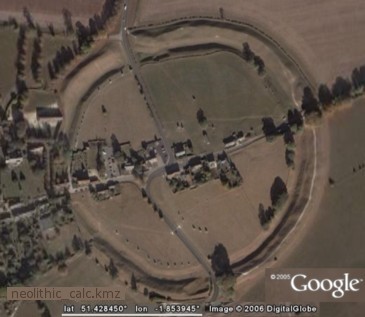
2009.01.27 - A recent e-mail exchange led to reconsidering the English foot as a geodetic construct. Long ago when dividing circumference by days per orbit I noted the result was nearly 100,000 yards. I'm told this has shown up in books, except as equator divided by days per year. I posted this in online discussion long ago, without much detail. I comment further now because I've been told confusion on this "coincidence" is in print. First, if a metric is geodetic, it will be related to land, not to sea level on the equator. Sea level is not a valid archaeological benchmark for the size of the earth due to sea level changes. Anyway, the size of the earth is just expressed, not determined at sea on the equator. A geodetic metric should reflect the arc meridian, the latitude, or the method used to determine the size of the earth. If the English foot fits the earth, it should fit the earth where the unit presumedly arose, on land in Britannia in the fog of long ago when sea level was different. Second, if a metric is related to circumference, it should be subdivided by an orbit number, not based on the year. The year is not equal to orbital circumference, it is shorter than solar orbit. A culture ignorant of this difference, the effect of axial precession, is less likely to utilize accurate geodetic metrics. So, calculating, at Avebury's latitude, a meridian degree measures 365,015 feet, not 365,256 as would be expected for days per solar orbit (1.0 : 1.00066). At Avebury, the degree of local meridian measure in feet presents, instead of days per orbit or year, a lunar constant number, 0.036501 rotations per lunar orbit. This Avebury meridian degree number string, 365,014.7 is quite precise in relation to the rotation : lunar orbit ratio; as determined centered on Avebury it is off by only 4.1 feet per degree. This represents earth's circumference to within 1500 feet accuracy IF the foot is supposed to represent this fundamental astronomical constant at Avebury. At Stanton Drew, Britannia's second largest stone circle, accuracy is within 90 feet of circumference, or three inches per degree. Avebury, the largest stone
circle and henge. Latitude = 360/7.
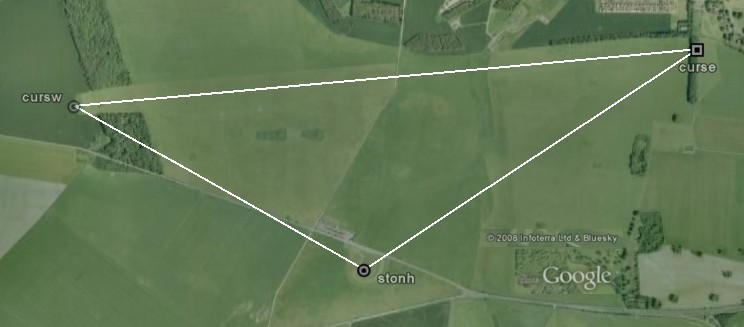
Distracted by lunar constants and given the astronomical import of 0.036501, of course I diverged. Avebury, while an important latitude at one-seventh of circumference, is not Britannia. Where to check next, Stonehenge or Thornborough, the Stonehenge of the North? Geodetic radius is a local variable; radius of curvature of the ellipsoid varies with latitude, being the longest at the pole and shortest at the equator. Thornborough is closer to the mean latitude of the island, and the radius is longer. So, archaeogeodesy.xls calculations set up, simply changing the site to Thornborough South provided 365,186.3 feet. Almost, and an interesting number, maybe even clever, but not days per orbit. The latitude in ancient Britannia where days per orbit matches feet per degree is 70 km north of Long Meg stone circle. Ring of Brodgar, another of the largest stone circles along with the inner Avebury stone circles and Long Meg—is too far north, but the mean latitude of Brodgar and Avebury provides 365,242.1 feet (1.0 : 1.0000011). IF the foot represents an astrogeodetic metric, this mean value string for the astronomical constant days per year represents earth's circumference to within 150 feet of accuracy. I conclude for Britannia that feet per mean meridian degree/1,000 equals near days per orbit or year. A fair and accurate statement would be, "Britannia's mean geodetic radius inscribes a circle about 365.25 times 360,000 feet in circumference." So, the foot fits that test, albeit mean latitude for Britannia is a fuzzy determination. Avebury henge and the five greatest stone circles of Britannia suggest the English foot, IF a geodetic metric, may precisely express astronomical constants. Nonetheless, these are not "intentionality" tests! A phrase is trying to turn from reflection on the calculations and results. "If the foot fits wear it." No. "For the foot to fit, where it." No. Okay, now I've got it, "How precisely the foot fits where matters." To put a fitting final punctuation to this point, let's not forget Stonehenge. At Stonehenge, there are 365,000 feet per meridian degree. "Does the foot fit Stonehenge?" seems to also be a fitting question. Addressing that question will be continued in discussions below, as this semester progresses. This story is just beginning to be told.
2009.01.30 - My next question is taking form, "Stonehenge's geodetic radius, to the top of the Sarsen Circle, inscribes a circle [365 * 360,000] feet in circumference, plus or minus how many inches?" In other words, "What is the precise geodetic radius length at Stonehenge, monument elevation included?" For the Stonehenge latitude, the archaeogedesy.xls output of 111,251.68 m per merdian degree is based on the form of the geoid. Taking elevation into account will alter the simulation of measure. If the question begs an immediate answer, enjoy the puzzle. I'm enjoying new features in the application designed for new questions. 2009.02.01 - Earlier, for this semester, I offered these questions: "Are we as 'wise' as humans were in prehistory?" and "If not, how would we know?" Consider how the foot fits Britannia at Stonehenge, precisely subdividing one meridian degree by 365,000—like a glass slipper on the Cinderella of monuments (elevation unaccounted for!). Yet those who try to fit the foot to astronomy and the equator both accepted an incorrect, close fit as good enough AND failed to notice the latitude of Britannia matches their inferred hypothesis of equatorial circumference divided by days per year producing the foot. This begs the question of wisdom today. "Did the builders of Stonehenge think they should meter their foot based on the equatorial circumference?" is the question the claim poses. Posing the question makes me ponder, "Were the builders of Stonehenge wiser than pseudo-science writers?" Are we wise enough to understand what the builders of Stonehenge knew or did not know? Were they wise about astronomy and geodesy, or would they have to ask, "What is geodetic?" Let's examine the evidence and the reasoning, and the methods. So also, let's consider in parallel who is the wiser? First, the foot has a very short history, with the recent standard originating in England based on an older, now lost standard rule. Standards of measure as old as Stonehenge are inferred elsewhere, so the deep antiquity question cannot be ruled out based on lack of evidence about the foot's origins. Absence of evidence is NOT evidence. Plus, the words rule and ruler have their multiple meanings since antiquity for a reason; standards of measure are as old as law giving. Second, "Close is good enough" is NOT an acceptable methodology for astronomy, metrology or geodesy. Any hypothesis that begins with an expectation that inaccuracy is the best we can expect of an ancient culture is unacceptable. We humans are capable of extremely fine measure and surveying. We are also capable of accurate astronomy. Humans are capable of science, and have been for longer than the time depths under discussion. Fact check: the foot does not fit the hypothesis at the equator. Approximation is all there is at the equator, at least until the ocean rises further. Plus, sea level was lower in the past. Third, Why don't the pseudoscientists think through the process of determining equatorial circumference? It's quite obvious noone would measure the sea along the equator, right? In fact, if you do not already know the earth is an oblate ellipsoid, measuring a meridian centered on the equator produces a false answer because the longitude and latitude angular units are not equal in length. Measuring the earth requires using the cosmos to determine two geodetic angles, then comparing the angles with their measured spatial relationship. This is most easily accomplished on a merdain arc, between two points forming a north-south line. The ellipsoidal shape of the earth becomes apparent AFTER comparing measures of meridians at distinct latitudes. Only after measures with high accuracy at several latitudes are compared can the figure of an equatorial circumference be deduced.
Eliminating "close is good enough" methods does not eliminate all short sightedness. If pseudo-science writers knew what geodetic means, obviously consideraton of where the earth was measured would have mattered, and the obvious historiography of geographic discovery would not have been overlooked. Obviously also, proving the pseudo-scientist ignorant does not prove the Stonehenge builder was equally ignorant. Cultural evolution is not a gradual climb with ever more erect posture and refined science. "Who is the wiser?" is neither a question of chronology, mean intelligence, nor technological wizardry, neither now nor then. 2009.02.10 - So, who is in the dark? Precession, the slow backward spin of the rotation axis' inclination defines the error in the quote above. Heath writes "a DAY" is one 365.242th part of the equator in longitude, when there are actually 365.252 days in solar orbit. The year is confused with orbit and only orbit corresponds to one circumference. Herein lies a cultural astronomy intelligence divide, the true-false, heliocentric-geocentric divide. Knowing the year-orbit difference removes a stumbling block to navigation and longitude determination, and to doing accurate astronomy easily. Knowledge of the motion of precession defines this difference in cultural astronomies. Just one wobble backwards during 26,000 years of only the inclination of earth's rotational reference frame in fixed, heliocentric space makes all the difference. If I were Howard Carson, the Motel of the Mysteries fictional archaeologist who was never too busy to entertain his helpers (Macauley 1979:31), and writing in 4,022 (this would be in Carson's later years, of course, after abandonng his "delicate" excavation kit, digging much deeper, and finding the older glyphs) the story in Carson's tome Deep Archaeology would go like this:
So, working in the dark is a great thing for astronomers, because you equate to the sidereal half of cosmic reference. People can be good civil calendar keepers and—blinded by culture and historical traditions—in the dark about taking astronomical and geodetic measure. Working in the dark is not a great thing for archaeologists. Part of the wisdom divide can be blamed on traditions and beliefs. However, culture is no excuse for not thinking. Thinking about astronomy requires counting, and counting reveals ratios. The proper combination of counting, observation, and logic reveals precession with precision. Asking "Am I wiser than the Greeks over 2,400 years ago?" consider the following story, handed down in part by Diodorus. Meton revealed to the public in Athens the nineteen-year circuit of a Great Year. History remembers the astronomer by naming the Metonic eclipse cycle after him. Today, archaeoastronomers and historians of science consider the Metonic cycle to be noteworthy as a short eclipse cycle with the eclipses on the same day of the calendar year 19 years later. Meton instituted a '19-year-eclipse' period calendar in Athens on the summer solstice of 432 B.C. While formatting Epoch v2009, I noticed the Metonic lunar orbit and lunar synodic ratio is more accurate than the Saros eclipse ratio. I asked, "Were ancient astronomers aware of this?" History affords some answers, in combination with the counting.
Geminus reports Callippus corrected the 19-year cycle, deducting one day every four Metonic periods, or 76 years comprising 940 months. Apparently, Callippus knew of the one day difference between days per 76 orbits and days per 76 years, after four Metonic cycles. The year-orbit difference infers Callippus knew precession. Callipus observed the sequence of the Metonic cycle numbers above against sidereal space. Observing the second Metonic eclipse occur, in the context of keeping a lunar and solar count, one observes the same specific sequence of the events in the table above:
Given the logic of geometry, you cannot
have the 19th synodic node precess (precede) the 19th circumference
orbit. The 19th node IS the 19th solar orbit, equaling 254.0062 lunar
orbits Comparison with the following formulations and counts illustrates why the sequence above solves a cosmic conundrum. This formulation reveals the precession wheels in the clockworks, wheels turning backwards and contradicting geocentrism. Eclipses allow observing what fraction over 235th lunar synodic periods occurs at 254 lunar orbits. When 254 orbits occur, there are 18.99954 fewer moons, hence only 18.99954 solar orbits have completed at 254 lunar orbits (254 / 18.99954 = 13.36875). From a tally of rotations, the value of rotations per orbit also computes (6958.70/18.99954 = 366.25624).
There is more supportive historical data, but with the counts, the sequence, and the "fit" of the numbers with theory this much should be obvious; the Ancients knew precession, the year-orbit difference.
2009.02.11 - The Metonic cycle history and Metonic eclipse clock methods reinterpret what ancient astronomers knew or did not know. You can watch and calibrate precession with the naked eye in just one Metonic eclipse cycle. A tiny sliver of circumference (19/25,770th of precession at today's rate) is very easy to measure when multiplied by the 350,000 lunar orbits per precession cycle. With this understanding, we can reinterpret the historical data in a new light. The longer the ruler, the better the accuracy. Likewise with counting, the longer the count the greater the accuracy of the ratios. Simple logic prevails; anyone who counts and thinks can see precession, and this ability has always been right before our naked eyes. Importantly to archaeology, a simple naked-eye method for demonstrating precession, of readily quantifying all astronomical variables, and of finding longitude alters the prehistoric context. Archaeology is all about context and chronology. New data and new information can force the scientist to return to the very beginning of the puzzle, to ask of necessity anew the same questions, knowing the answers will now all be different. Fundamental knowledge didn't just shift gears, there are new gears in the works and that changes everything, just like precession. Considerable ancient records of historical astronomy can now also be re-examined in light of a new context, accurate ancient knowledge of astronomy. When I ask anew "Does the Foot Fit Britannia?" or "Are we wiser?" how does the change in the context impact your thinking? Long ago, when I studied the arc distances of the Mayan pyramids, an error kept recurring in a statistical accuracy routine. I recorded the incongruity with hypothetical as the proportion of hypothetical equaling one, the ratio of the actual result to the expected whole. That equalized all line lenghts to reveal proportionality error in the hypothetical framework. My reasoning was if the Ancients are 'off the mark' in their fundamental astronomy, the impact would be "to proportion." I did notice a recurring proportion error, and the error was quickly recognized—the inverse of precession. Then I discovered the Ancient's arcs were correct, and the recurring error was in my analytical modules. The hypothetical lengths did not fit because I had made the mistake my culture taught me to make, I had divided circumference by days per year. In this context the Maya taught me they knew precession, and taught me who was wiser. So, I had to go back to the start and ask every question over again, and every answer was proportionally different, of course. To bring my metaphors full circle, I was working in the dark while the Ancients were doing accurate astronomy in the dark. Their monuments still show us their light, an understandable codex of accurate astronomy in new context. Thanks to the noble efforts of our Ancestors, I feel I am a bit wiser. I leave this thread having added new context for two question, now well asked I hope, "Are we as 'wise' as humans were in prehistory?" and "If not, how would we know?" While "Does the Foot Fit Britannia?" remains a 'fitting' question, hopefully you now find yourself in the dark with much bigger questions.
|
|||||||||||||||||||||||||||||||||||||||||||||||||||||||

# 93,029 rotations #